
News Leaders from The Guardian and Reuters Focus on Impact of AI on Journalism and Public Trust
The Globe and Mail Foundation’s inaugural Editing Democracy event asks how media is assessing risks and rewards of powerful new technology
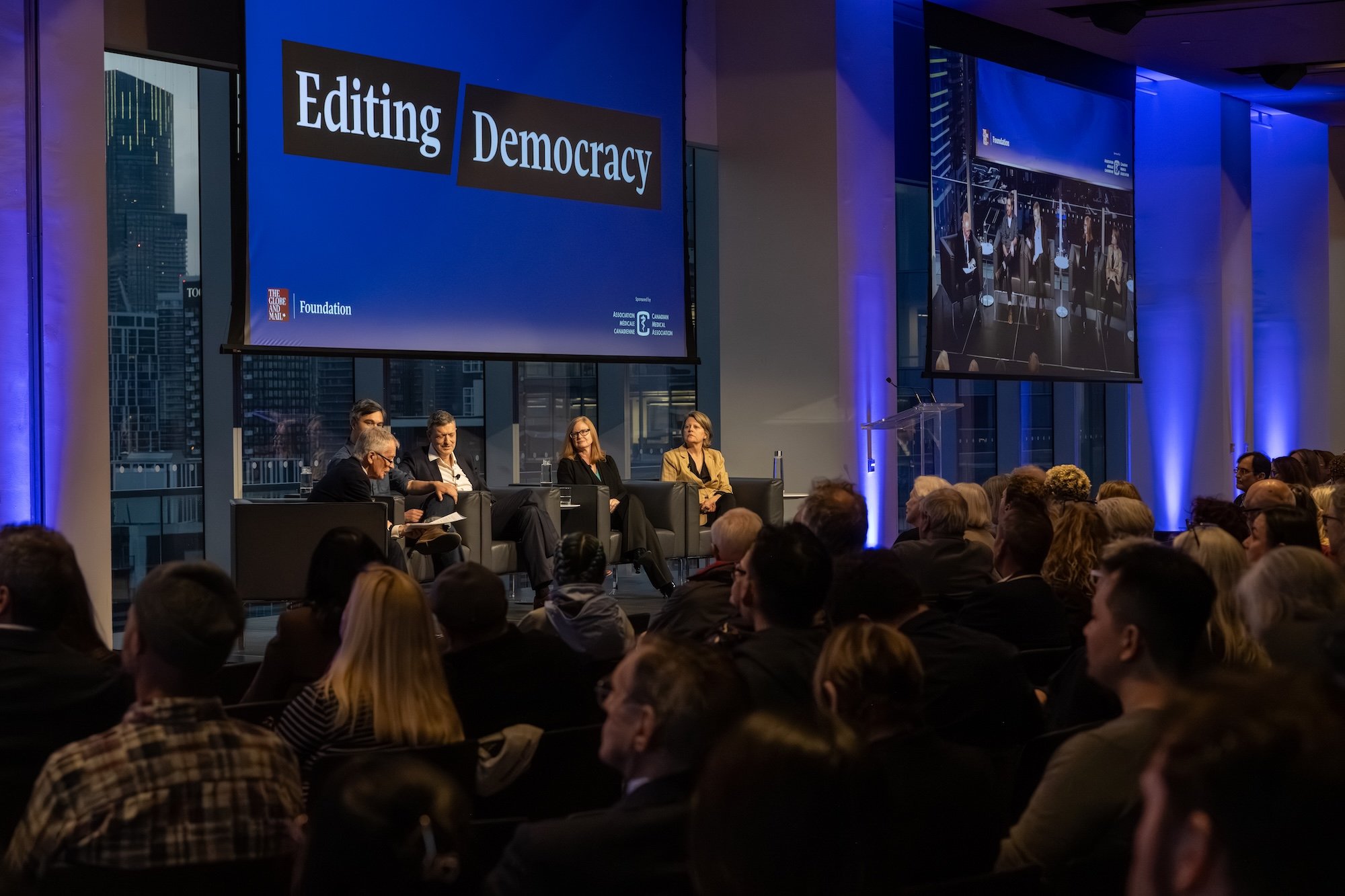
Left to right: Phillip Crawley, Nicholas Hune-Brown, Caspar Llewellyn Smith, Glenda Crisp, and Sally Buzbee. Photography by Mike Hyttinen.
Link to event recording: https://www.globeandmailfoundation.com/editingdemocracy
Toronto, Canada — The threats and opportunities facing media organizations, from the torrent of digital misinformation to rapid advances in AI, were the focus of news leaders and experts on AI at The Globe and Mail Foundation’s inaugural public event, titled Editing Democracy, and sponsored by the Canadian Medical Association (CMA).
“AI is already changing how people seek and receive health information,” said Margot Burnell, President of the CMA, in her introductory remarks. “The physicians of Canada share an important responsibility with the news media, helping people make informed decisions based on accurate, timely, and trustworthy information. Today, that responsibility is being reshaped by the rapid growth of AI,” she said.
Phillip Crawley, Chair of The Globe and Mail Foundation, and former publisher of The Globe and Mail newspaper moderated the high-profile media panel, including Sally Buzbee, News Editor for the US and Canada, Reuters; Caspar Llewellyn Smith, Chief AI Officer, Guardian News & Media; Glenda Crisp, CEO, The Vector Institute; and Nicholas Hune-Brown, Executive Editor, The Local.
“Artificial intelligence is changing the way we live and work. It’s doing it very quickly. What does that mean for the future of news?” asked Crawley to the panel.
The 90-minute conversation covered the challenges faced by media organizations to retain public trust in an age when misinformation threatens so many sources of news, and how newsrooms are keeping pace with rapid advances in AI, while assessing which of its aspects should be incorporated into journalistic practices. The implication of this powerful new technology on news gathering is profound, and there is so far no industry consensus for how journalists should adopt its varied abilities and tools.
The Guardian’s Llewellyn Smith pointed out that “news media already largely surrendered distribution of our journalism to big tech,” and that AI threatens to do that on steroids. “Everyone is worried in the industry at the moment about things like AI overviews,” he said, which allow news readers to use AI to follow world or local events, without needing to acknowledge the news source, which he pointed out, will further disrupt the already fragile business models of leading media organizations.
Meanwhile, with the U.S. midterm elections on the horizon, Reuters US editor Buzbee was grappling with how to vet the flood of manufactured photographs and synthetic information being disseminated to the public, weighing the implications on democratic systems, while showcasing the immense value of verified information that responsible journalism provides to the public.
“We have to talk to people about our standards,” said Buzbee, citing how a Reuters photographer successfully captured a photograph of Venezuelan President Nicholas Maduro after he was seized by the U.S. military and transported to New York. At that time, fake images of Maduro purportedly on U.S. soil were flooding the internet, which made the verified Reuters image immensely valuable to news organizations and audiences across the world.
Buzbee then warned of the implications of fake photos or misinformation being released within days or hours of a given election, leaving voters scrambling to assess what was valid.
“I think journalism really has the opportunity to be the truth teller,” responded Vector’s President and CEO, Crisp, who helms one of Canada’s leading AI institutes and previously steered data and analytics at Thomson Reuters. “I’d like to see journalism harness AI and get the benefits from it, but I’d also like to see journalists disclose how they’re using AI.”
A case study from The Local’s Hune-Brown offered a chilling cautionary tale, as the editor relayed to the audience and colleagues how he had accepted a well-crafted pitch from a prolific freelance journalist, only to learn that the “journalist” had managed to publish dozens of fake news articles in established publications spanning multiple countries, most likely with the aid of AI.
After chronicling his investigation in The Local, Hune-Brown was astonished at the number of editors from across the globe he heard from, he said, “who've experienced the same thing that I'm experiencing right now, which is that the whole system of how we run our newsroom— which is pitching, working with freelancers— is fully broken.” Hune-Brown and his team have since introduced an AI policy to their media organization.
Other themes explored during the panel included the media’s role in maintaining a resilient democratic society, possible opportunities for investigative journalists using AI capabilities, and the rise of medical misinformation as more people consult AI directly instead of seeking professional medical guidance.
Laura Lavie, Executive Director of The Globe and Mail Foundation introduced and closed the event, highlighting the increased importance of fact-based reporting in this era of massive technological disruption. “Canada still has real guard rails, a strong, free press, institutions that truly serve the public, and a society that holds power to account,” she said. “We must never take any of this for granted. These values protect our democracy.”
The event was the first of the Editing Democracy series, which features leading journalists and thinkers discussing timely issues and challenges impacting the practice of journalism. The discussion was video recorded at The Globe and Mail Event Centre in front of a packed audience in mid-March and is available to watch in its entirety at The Globe and Mail Foundation’s website: www.globeandmailfoundation.com (for the recording visit: www.globeandmailfoundation.com/editingdemocracy)
---
About / The Globe and Mail Foundation
The Globe and Mail Foundation is a Canadian charity dedicated to protecting and promoting excellence in journalism.
With an educational mandate, the foundation delivers programming that enhances media literacy, deepens Canadians' knowledge and understanding of issues of the day, and supports high quality training for journalists.
Ensuring access to clear-eyed, fact-checked information is critical to the health of our society, and to democracy at large.
The Globe and Mail Foundation is proud to support the media ecosystem in Canada and abroad, and contribute to a future in which journalism thrives.
Please visit our website and sign up for our newsletter to receive further announcements:
globeandmailfoundation.com
For inquiries, contact:
Laura Lavie
Executive Director
The Globe and Mail Foundation
laura@globeandmailfoundation.com
