
Globe and Mail Foundation, Ukraine’s 2402 Foundation train journalists to handle war
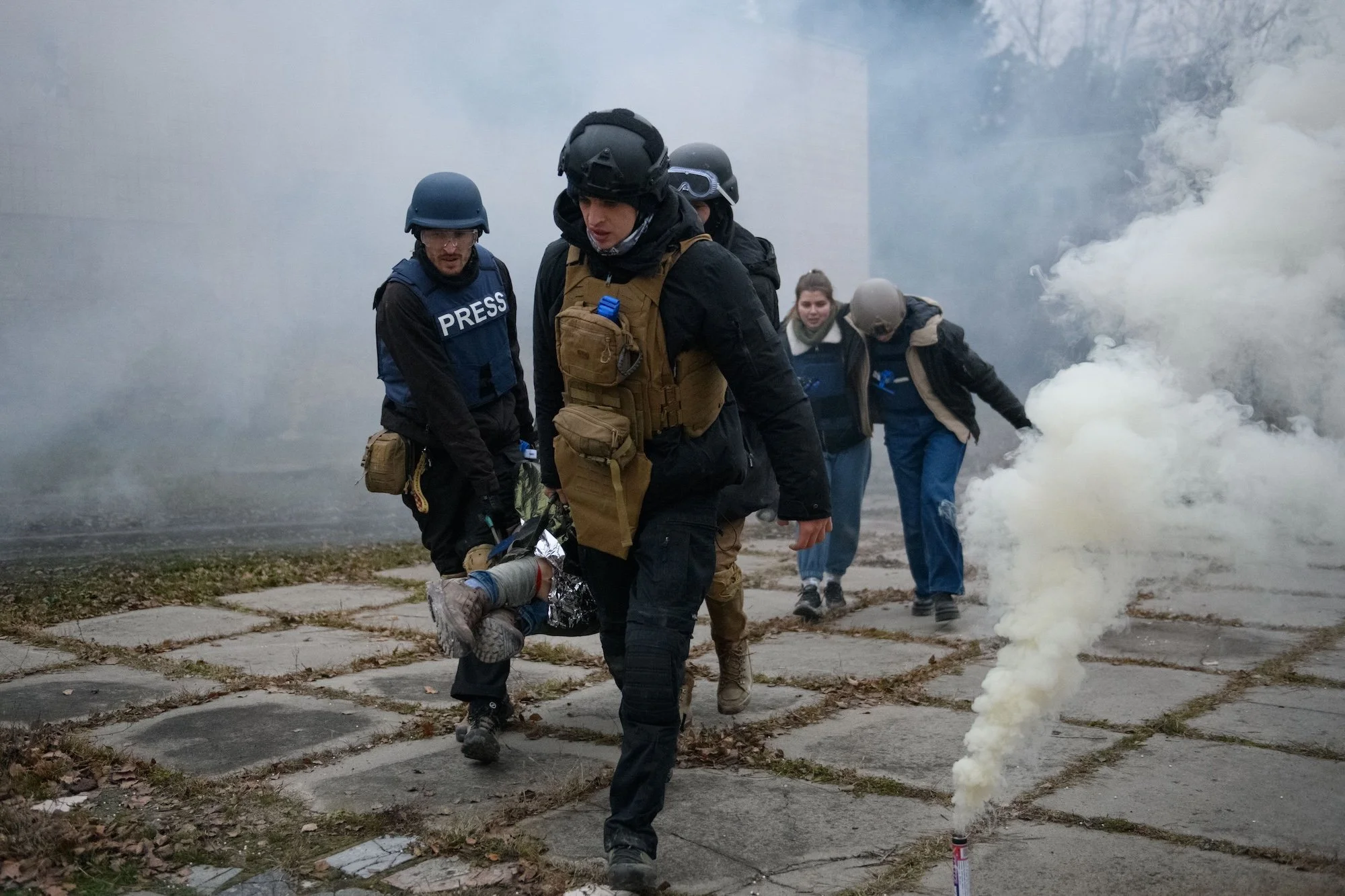
Photo credit: Olga Ivashchenko
Since the start of the Russian invasion of Ukraine nearly four years ago, journalists have been reporting from the front lines in a technologically advanced war, with drones deeply intensifying risk.
In December, 27 Ukrainian journalists who frequently work near a shifting front in the eastern part of the country took part in an innovative training program on reporting from hostile environments under drone attack.
The new joint initiative from The Globe and Mail Foundation and Ukraine’s 2402 Foundation (Daily Humanity) offers journalists an intensive three-day course on risk assessment, safety and critical first aid working on an ever-evolving battlefield.
Particularly new is the drone training, which teaches journalists and media support staff how to analyze risks and respond.
“The war has changed so much, and the way we cover the war and stay safe is changing with it,” said The Globe’s senior international correspondent Mark MacKinnon, who has reported from Ukraine for more than two decades.
“We didn’t talk about drones at all back in 2022 and now they’re a constant conversation. For anybody going anywhere near the front line, it’s about understanding what distances drones can cover and how to react if we see one,” Mr. MacKinnon said.
As part of the workshops, Ukrainian journalists studied the model of Kherson, with lessons on how drones operate when they are hunting cars. They learned about various types of drones, the sounds they make and the weapons they carry.
“We went into a simulation where we were literally being hunted by drones and trying to take cover and deliver first aid to our colleagues while drones were still overhead,” Mr. MacKinnon said. “I’m sure that will save lives.”
Journalists got an opportunity to handle drone detectors, technology that identifies and tracks remote aircraft. They participated in Hostile Environment and First Aid Training (HEFAT), and a session on journalism ethics, including maintaining independence when you’re covering your own country’s military.
“Ukrainians, they’re the ones who are the world experts in war corresponding that has come to their country and to their lives,” Mr. MacKinnon said. “We were just facilitating Ukrainians teaching Ukrainians.”
With more courses planned this month and in April, the project will help Ukrainian journalists work more closely with news organizations overseas.
“We want to protect the reporters who risk their lives daily to keep citizens informed, regionally and globally,” said Laura Lavie, executive director of The Globe and Mail Foundation, a Canadian charity focused on enhancing media literacy and supporting training for journalists.
The foundation contributed just as Ukrainian NGOs are facing a deepening funding crisis, with the abrupt withdrawal of USAID support last year.
A Ukrainian initiative, the 2402 Foundation (Daily Humanity), helped spearhead the courses. “2402” stands for the 24th of February, the first day of the Russian invasion in 2022. The Ukrainian program works to equip, train and protect journalists and other civilians working on the frontlines during full-scale war.
“They were quick to understand that basically every journalist in Ukraine was now a war correspondent. If you were covering sports or theatre before the war, now you were a war correspondent,” Mr. MacKinnon said. “A lot of Ukraine journalists weren’t prepared for this and so 2402 took the lead on that.”
The foundation’s co-founder and executive director Kateryna Sergatskova said Ukraine finds itself at the centre of the world’s most technologically sophisticated conflict.
“Locals are facing extreme threats: from very fast and dangerous drones, to missiles and guided aerial bombs,” Ms. Sergatskova said.
“Our mission is to ensure that journalists working to bring the truth about the war to the world can operate safely and be aware of the risks they take.”
