

September 2026
FEATURED INTERVIEW
Iva Sidash
Documentary Photographer • Kyiv, Ukraine
Participant, Training Program for Journalists Operating in High-Risk Environments
The Globe and Mail Foundation
When did you know you wanted to be a photojournalist?
I started my journey in photography in 2019, and from the very beginning I knew I wanted to work in documentary photography. By then, Russia’s war against Ukraine had already been going on for five years, and it inevitably shaped the reality around me and the stories I was drawn to.
I understood that photography could be a way of getting close to people and experiences that might otherwise remain unseen. Photojournalism eventually became the place where those interests came together for me.
Can you describe one or two documentary projects that you've worked on in the past year?
One of the projects I have been working on is Seeing the Unseen, which follows families living in villages close to the frontline in Ukraine. I began the project in Slatyne, where I photographed Aliona and her two children, who continue to live around 13 kilometres from the frontline.
I am interested in the everyday reality of people whose lives are shaped by war and constant danger, yet whose experiences can easily disappear behind the larger news of the war. The project looks at family, childhood, home and love during war time.
How was your experience in the training program facilitated by The Globe and Mail Foundation and 2402 Foundation?
It was a wonderful experience and extremely useful. What I particularly appreciate about these trainings is that they are very practical and connected to the reality in which journalists in Ukraine are working.
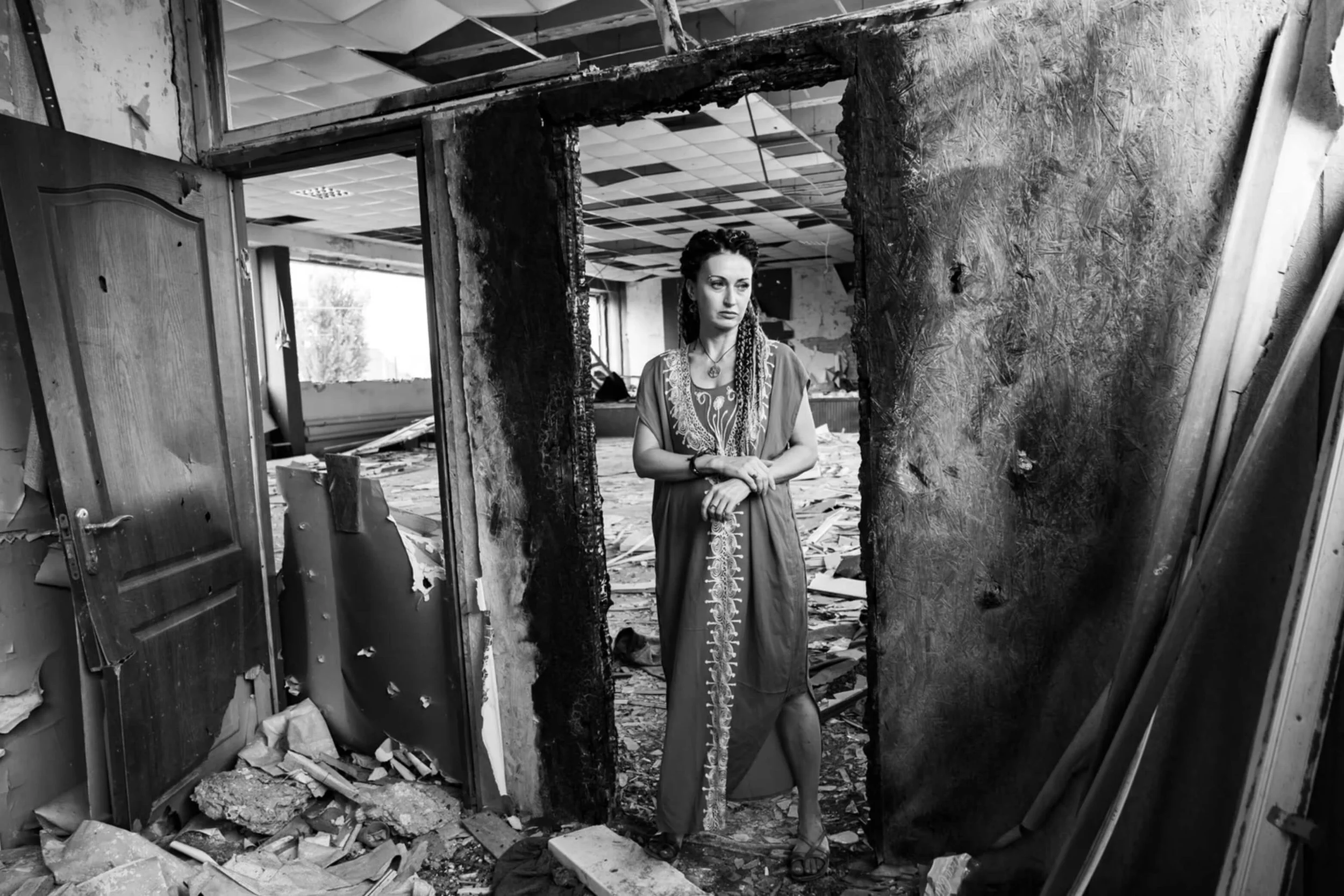
Photo from Iva’s project, Seeing The Unseen
Did the program teach you skills that you can use in your professional practice?
Absolutely. For me, one of the most important parts is not only learning specific skills, but restoring awareness of risk.
When you live and work in an environment of constant danger, something strange happens over time: you become accustomed to it. The level of fear naturally decreases, and with that you can also become less attentive to risks that should never feel routine. This training was an important reminder of those risks and, more importantly, gave us practical ways to recognise, assess and respond to them.
That is something I can use directly in my work, especially when working close to the frontline or in areas affected by drones, shelling, mines and unexploded ordnance.
I think continued training like this is especially important for Ukrainian journalists now. We have been working through years of full-scale war, and experience can make you more capable, but it can also make danger begin to feel normal. Having the opportunity to return to training, refresh your knowledge, learn about changing threats and question your own habits is incredibly valuable.